


Hairline lowering surgery
(forehead reduction)
Restoring balance and proportion to the upper face
When the forehead feels out of proportion
For some women, a high or prominent forehead feels out of sync with the rest of their features.
This may be due to genetics, a naturally high hairline or subtle changes over time. Even when the face is otherwise balanced, excess forehead height can draw attention upward and affect how facial proportions are perceived.
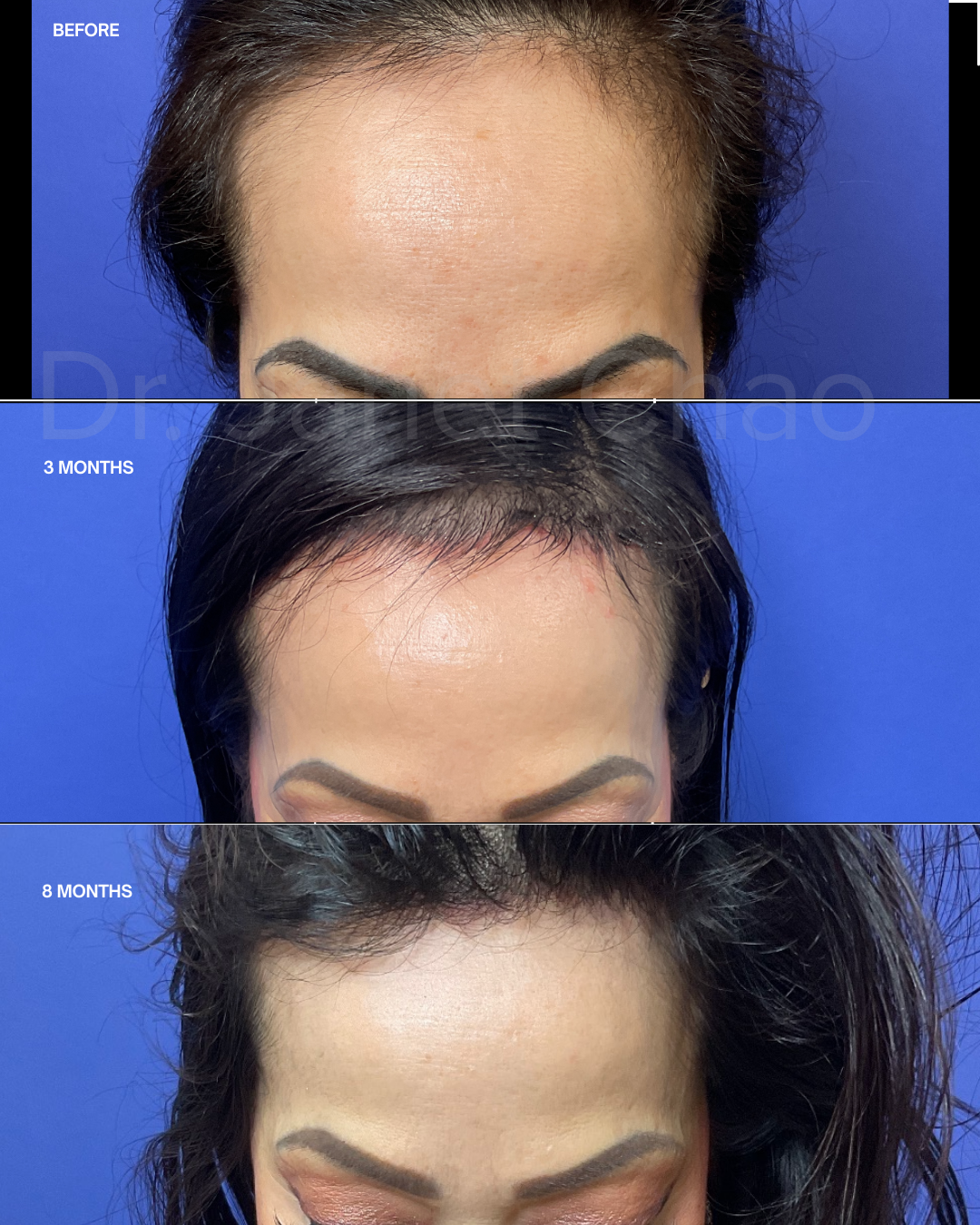
Hairline lowering surgery (also called forehead reduction) addresses this imbalance by carefully advancing the hairline forward, reducing the vertical height of the forehead. When performed thoughtfully and for the right patient, it can bring the upper face into better proportion with the eyes, nose and midface, creating a softer and more harmonious overall appearance.
The goal is not to create an artificially low or shrunken hairline, but to restore balance in a way that looks natural, intentional and appropriate over time.
“She was thorough and explained the procedure, and what she could or could not do, and she answered all of the questions I had. I’m now post-surgery, and the results are amazing!”
— Hairline lowering surgery patient
Who this procedure is (and isn’t) right for
Hairline lowering surgery may be appropriate for women who:
Feel their forehead is disproportionately tall relative to their facial features.
Have a stable hairline and sufficient scalp flexibility.
Desire a permanent solution rather than camouflage or styling workarounds.
Are seeking proportional refinement rather than an exaggerated change.
Just as importantly, this procedure may not be recommended if:
Scalp mobility is limited.
Hair loss patterns suggest future recession.
Another approach (such as hair transplantation or nonsurgical options) would better address the concern.
Long-term hairline stability cannot be confidently supported.
A consultation will help determine whether hairline lowering will be right for you
Dr. Janet Chao Pearl’s approach to hairline lowering
Hairline lowering is a technically demanding procedure where planning matters as much as execution. Incision placement and closure technique all influence how the hairline looks immediately and how it heals over time.
My approach emphasizes:
Precise preoperative measurement and candidacy assessment.
Incision placement designed to heal discreetly within the hairline.
Respect for natural hair direction and density.
Long-term stability of the hairline, not just immediate change.
This procedure is recommended only when it serves the patient’s facial balance and future appearance. When it does not, that guidance is given clearly and thoughtfully.
What to expect from Dr. Chao Pearl
Timeless Faces is a boutique, concierge-style facial plastic surgery practice designed to provide a highly personal and continuous experience of care. This structure allows me to remain intimately involved at every stage of the process and to work thoughtfully with patients for whom surgery is truly the right choice.
From consultation through recovery, care is direct and closely managed. Surgical decisions are made carefully, expectations are discussed openly and follow-up is intentional rather than transactional.
Your evaluation includes:
A detailed assessment of facial proportions and hairline position.
Review of scalp flexibility and hair characteristics.
An honest discussion of what hairline lowering can (and cannot) achieve.
Consideration of how results will look as the face continues to change.
If surgery is appropriate, the plan is tailored carefully. If it is not, that guidance is offered with the same clarity.
Recovery and healing
Hairline lowering surgery is typically performed under anesthesia and completed in a single outpatient setting. The procedure involves advancing the scalp forward and removing excess forehead skin, with careful closure designed to support optimal healing.
Recovery generally includes:
Swelling and numbness along the hairline in the early healing phase.
Gradual return to normal activities over the following weeks.
Temporary hair shedding, with regrowth over weeks to months as healing progresses
Incision healing and hair regrowth patterns are discussed in detail before surgery, so expectations are clear and realistic.
Practical details
Consultation: Initial review begins through a secure online form, followed by transparent pricing and next steps if appropriate.
Consultation fee: Applied toward a future procedure.
Scheduling: Surgery is scheduled only after careful planning and mutual agreement.